Welcome on this website!
Hello,
welcome to my website for beginner aquarists. This website serves as a basic guide for anyone who would like to start with aquarium keeping. The content is based on my own experiences and knowledge that I have gained over the years.
I wish you pleasant reading and much success with keeping your aquarium animals.
Basics of Aquaristics
What We Will Need
Here you will find a list of basic equipment needed for the proper operation of an aquarium.Equipment
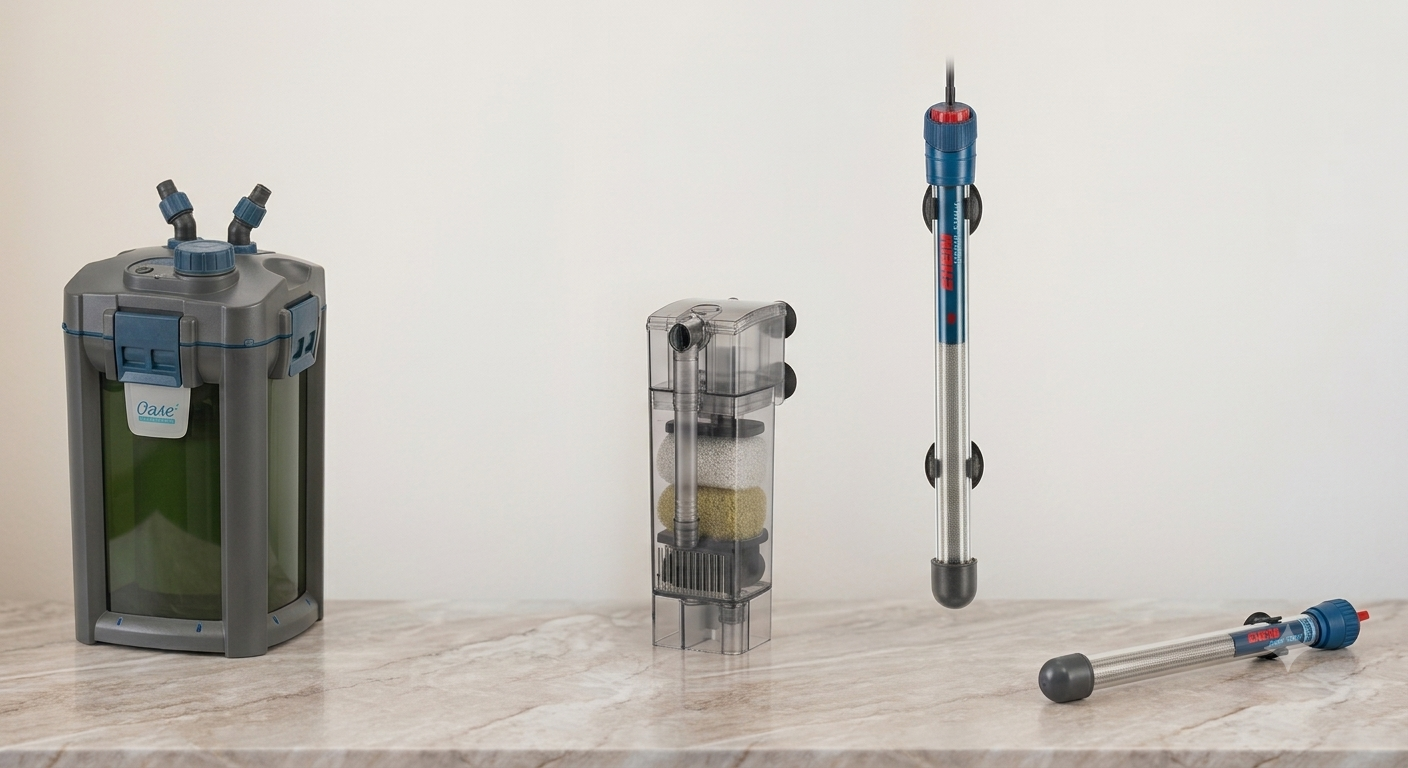
Filtration
Filtration is one of the most important parts of an aquarium. It cleans and circulates the water, similar to the heart and kidneys in the human body. Without filtration, an aquarium is harder to establish and gets dirty faster.Internal Filter
An internal filter contains a motor and a filter sponge and is placed directly inside the aquarium.External Filter
An external filter is mainly used for larger aquariums. It is placed outside the tank and connected with hoses.Heater
A heater maintains a stable water temperature and helps quickly warm up the water after a water change. The heater power is selected according to the aquarium size, for example 25 W for smaller tanks and 100 W for larger aquariums.Lighting
Light is important for plant growth and the proper daily cycle of aquarium animals. It can be LED or traditional fluorescent lighting.Lighting Duration
The aquarium should not be lit for more than 8–10 hours a day. Too much lighting encourages algae growth.Aeration
Aeration is not always necessary. It is mainly used in overstocked aquariums or as a decorative element.CO2 Injection
CO2 injection is usually not recommended for beginners due to the higher cost and the more demanding care required for plants.Aquarium Placement
The aquarium should not be placed in direct sunlight or near a heater. This could cause overheating and excessive algae growth.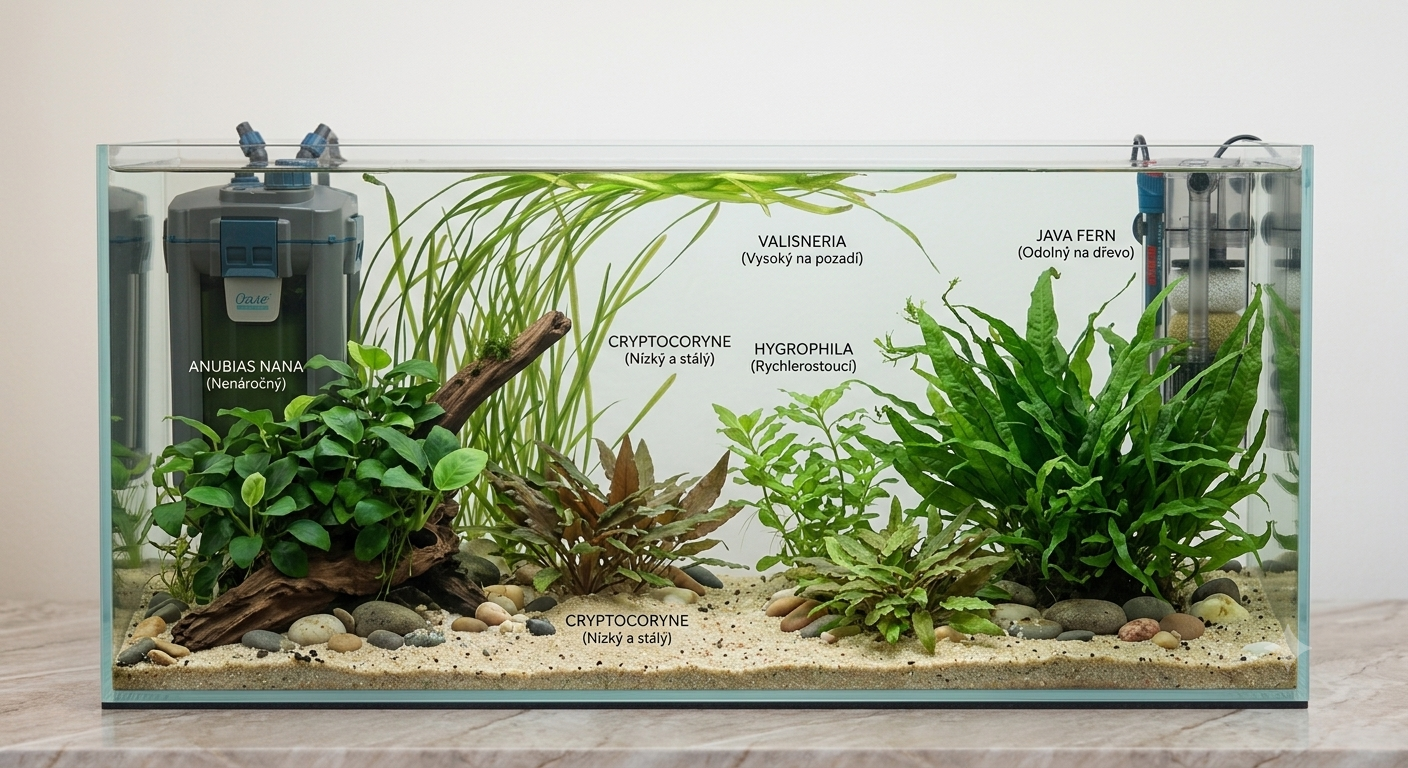
Plants are important
Why Plants Are Important
Plants help maintain a healthy aquarium ecosystem by consuming excess nutrients that could otherwise support algae growth.Artificial or Live Plants
Live plants are always the better choice. Artificial plants can injure fish with sharp edges, cause stress with bright colors, and do not remove nutrients from the water, which can lead to algae growth.Where Not to Place Plants
Avoid plants in aquariums with fish that dig them up or eat live plants, such as some cichlids.Jungle or Few Plants?
A densely planted aquarium is usually better. Plants provide fish with natural shelter and hiding places while reducing algae by consuming nutrients. Fast-growing plants are especially useful for keeping the aquarium balanced.Types of Plants
Stem Plants
Stem plants are ideal for beginners because they grow quickly and are easy to propagate.Anubias Plants
Anubias plants are resistant and decorative. They can be attached to decorations or planted in substrate, but the rhizome must always remain above the substrate to prevent rotting.Water Sprite
Water sprite is a fast-growing and easy plant that can be used for decoration or planted in the substrate. It quickly spreads and helps fill the aquarium.Carpet Plants
Carpet plants are not recommended for beginners because they usually require CO2 injection and more demanding care.Red Aquarium Plants
Red plants are also unsuitable for beginners because they require strong lighting and CO2 injection.Beware of Snails
Be careful when buying plants. If you see small snails on them, it is better not to buy them. Snails can quickly multiply and overpopulate the aquarium. If they appear, they can be removed using special treatments or with assassin snails (Helena snails), which naturally feed on unwanted snails.Liquid CO2 Is Not Gaseous CO2
Liquid CO2 products are not a replacement for real CO2 injection. They usually have limited effect, so they are better avoided.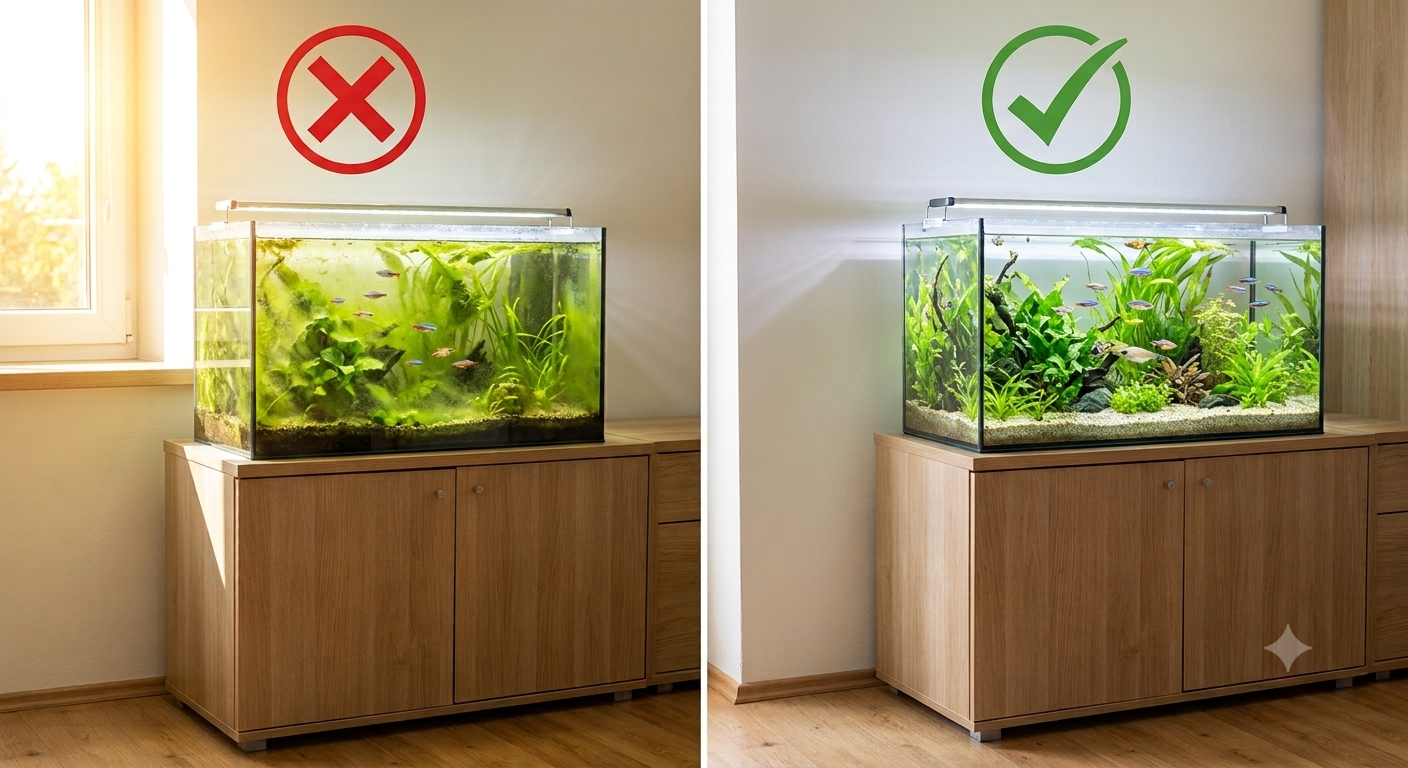
Starting new aquarium
Aquarium
An aquarium for fish is chosen mainly according to its size. Beginners are usually advised to choose a larger aquarium because it gets dirty more slowly and provides a more stable environment.The aquarium should also be selected according to the animals we want to keep. Two-liter containers for betta fish are not aquariums, but unsuitable living conditions. A fish kept in such a small space has no room to swim, which can lead to stress and health problems.
Substrate
The most commonly recommended substrate is clay or black gravel with a grain size of 2–4 mm. Silica sand and other types of substrate can also be used, but brightly colored sands should be avoided because they are unnatural and may stress fish.Rocks
There are many types of aquarium rocks available, such as pebbles or Seiryu stones. Rocks are used to create hiding places, decorations, or a more natural appearance in the aquarium.Roots
Aquarium roots are popular decorations, but some may float when first placed in water. Therefore, it is recommended to soak them in water beforehand until they become saturated and sink. Aquarium plants can later be attached to the roots.How to Set Up an Aquarium
First, clean the aquarium with water and vinegar and dry it thoroughly. Then attach the background and add the substrate, shaping it into the desired landscape. After that, place the rocks, roots, and plants.Once the decoration is complete, carefully fill the aquarium with water, for example by pouring it over a bag or another object, so the created landscape is not damaged. Then install the filtration and heater. Always follow the minimum water level mark on the heater to prevent damage.
The filter and heater should not normally be turned off. They should only be turned off during cleaning or maintenance.
The first fish should be added to a newly set-up aquarium after approximately one week.
The first days after the foundation
First Week
During the first week, do not interfere with the aquarium in any way and do not add any animals. Only provide lighting for a maximum of 4 hours per day.Second - Third Week
You can add fish to the aquarium, but if you introduce new fish later, wait at least 14 days before adding more.Fourth Week
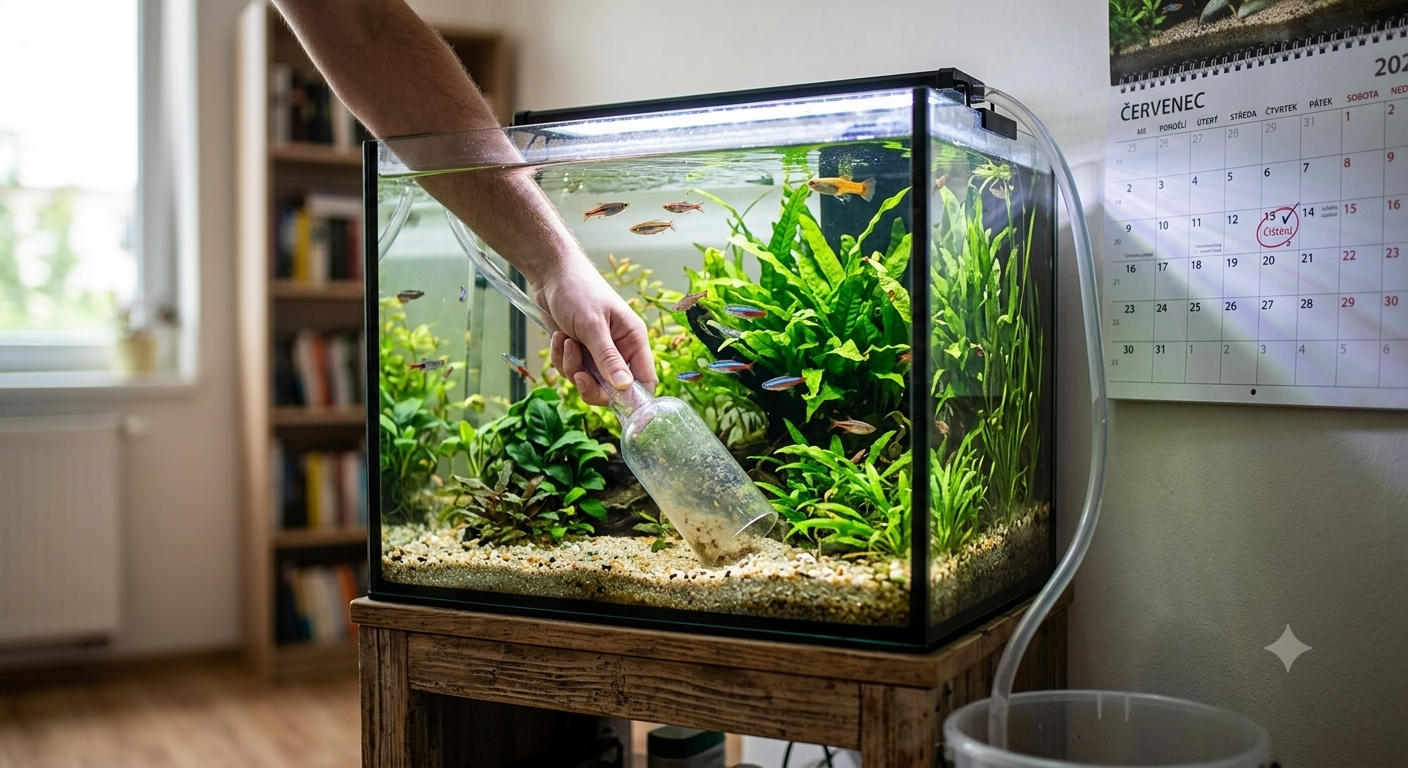
Clean the aquarium using a gravel vacuum and replace half of the water. Never replace all the water at once, as this would remove beneficial bacteria and could harm the aquarium ecosystem.How Often Should You Clean the Aquarium?
The aquarium should be cleaned once a week.The First Six Months of the Aquarium
After six months, you can clean the filter for the first time. Rinse the filter material several times in aquarium water to avoid killing beneficial bacteria. At this point, the aquarium should be well-established and stable.